

Crash Course + All-Subject Prep
More information
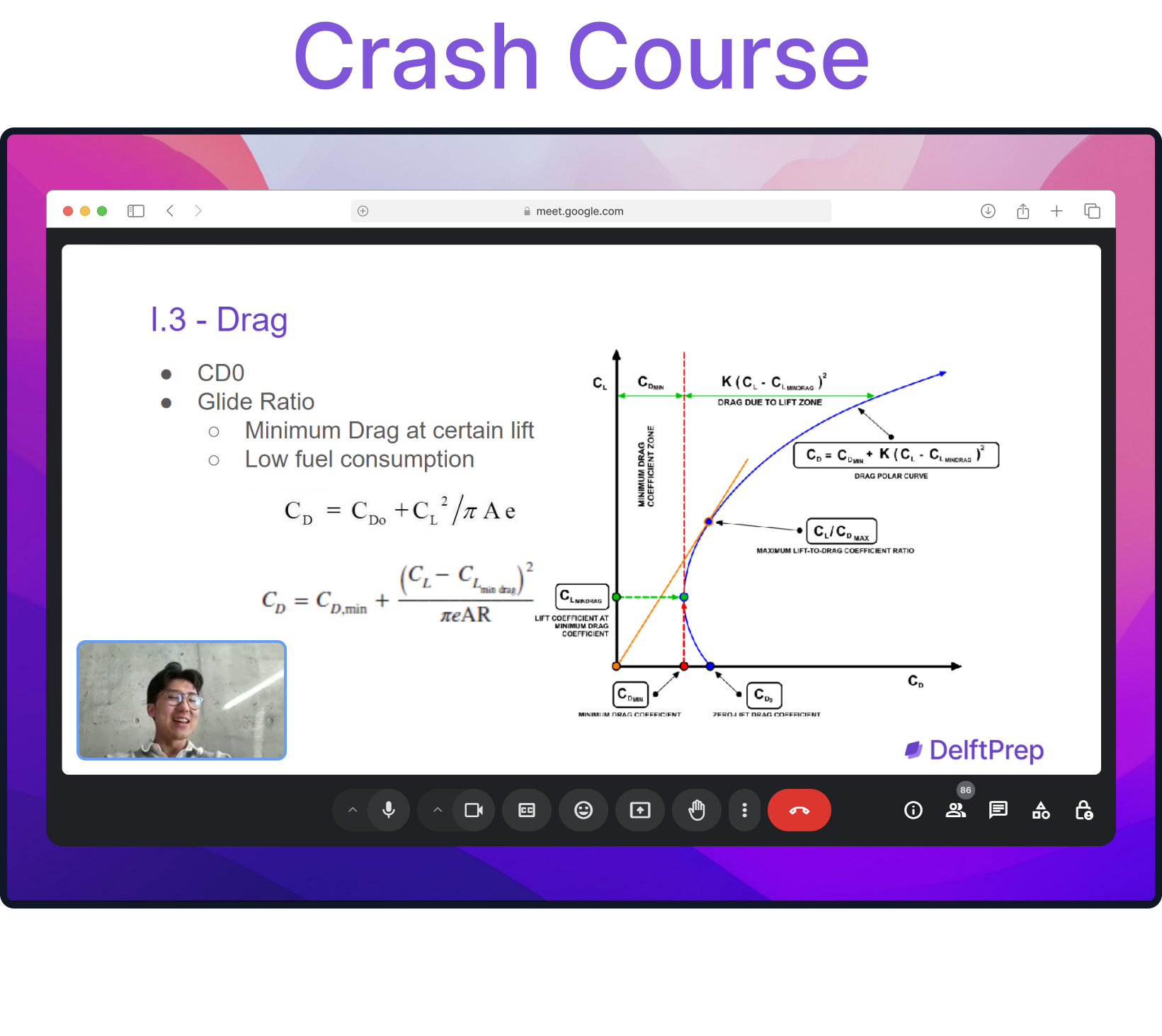
This package combines access to practice exams and a 2-day crash course for the TU Delft Aerospace Engineering entrance exam. Practice exams in Mathematics, Physics, and First-Year Topics are based on the latest formats, featuring automatic grading and detailed solutions. The 2-day crash course focuses on the First-Year Topics, covering essential concepts and strategies to help you prepare effectively.

Join our intensive 2-day crash course, designed for students who want to excel in the TU Delft Aerospace Engineering admission process. This course focuses exclusively on the First-Year Topics, providing a thorough understanding of key concepts, practical tips, and problem-solving strategies tailored to the TU Delft Aerospace Engineering curriculum and entrance exam requirements.
Dates: February 21st and 22nd 2026
Timing:
Sessions are conducted from 9:00 AM to 5:00 PM CET.
Lunch breaks are scheduled from 12:30 PM to 1:00 PM.
Course Breakdown:
- Intensive Learning: Over two days, we will cover the entire First-Year Material syllabus, with a focus on theory, examples, and tips that are specifically designed for the entrance exam.
- Interactive Q&A: Each day includes dedicated time for interactive Q&A sessions, allowing students to ask questions and clarify challenging topics.
- Customized Content: One week before the course, we will reach out to enrolled students to gather any specific questions or challenges they face. These will be integrated into the course content to ensure all key areas are addressed.
Additional Information:
All course materials, including recorded sessions and notes, will be made available online for registered students after the course is completed.
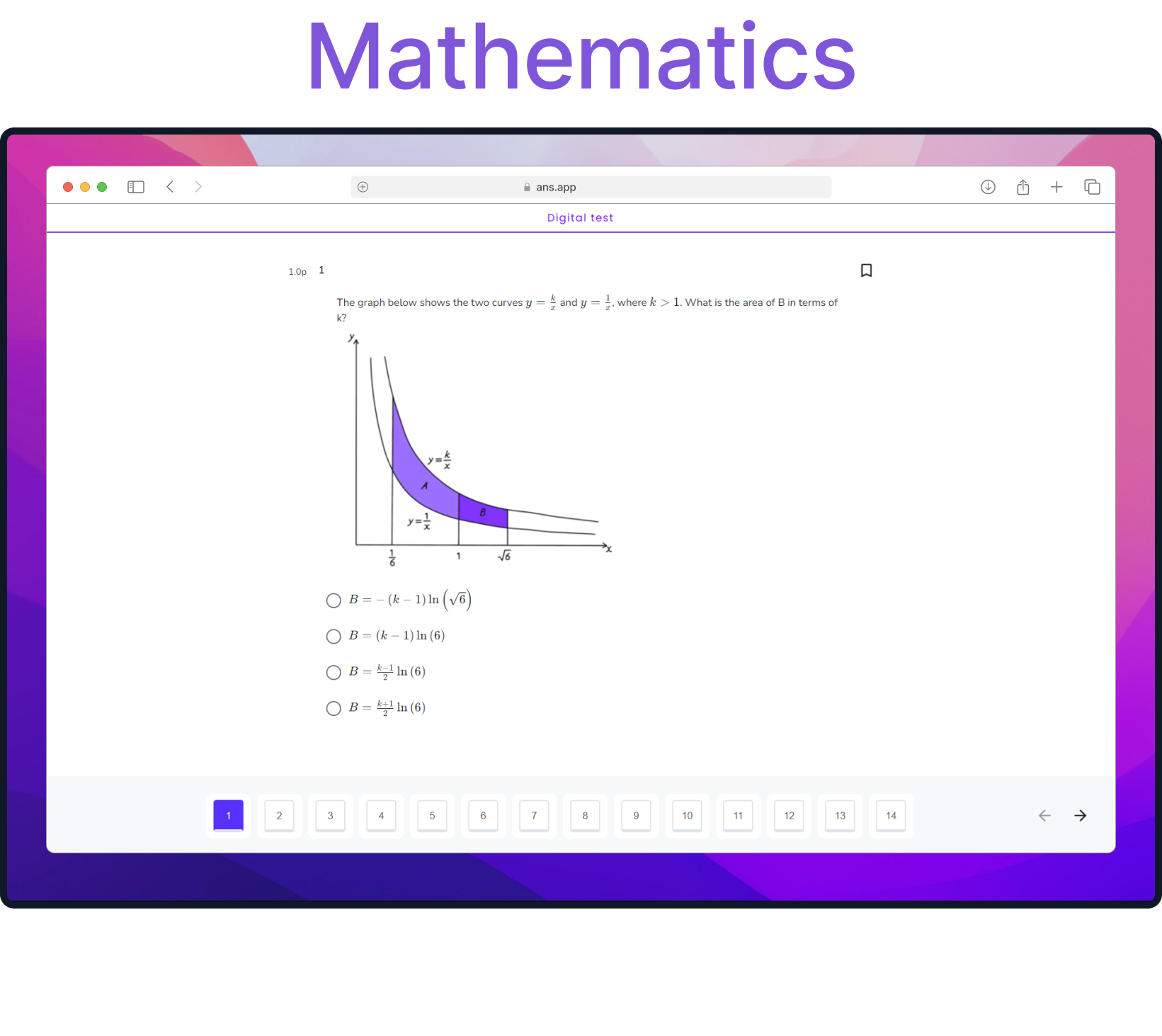
Practice your Mathematics skills with exams tailored for the TU Delft Aerospace Engineering entrance exam. The exams cover key topics such as functions, calculus, and trigonometry, based on the content you’ll encounter. Each exam is automatically graded, and you can review step-by-step solutions to understand each problem better.
The math practice exams include questions on the following topics:
- Functions and Graphs: recognition and drawing of polynomial functions, root functions, power functions, logarithmic functions, analyze and draw transformations of these standard functions, determine limits, domain, range, asymptotes and symmetry points, inverse functions
- Algebraic Solving: isolating variables in an expression, rearrange expressions into simplified form, find roots of functions with factorization, solve system of linear equations
- Differential Calculus: derivatives of standard functions, application of product/quotient/chain rule, first and second derivative and analyzing local maximums and minimums and local concave and convex behavior, inflection points, solve optimization problems
- Integral Calculus: limits of integration, definite/indefinite integrals, calculate integral of standard functions, determining surface area, volume of a solid revolution, arc length and mean value of a function
- Trigonometry: functions such as sin(x), cos(x), tan(x), unit circle, exact values of basic trigonometric functions for multiples of angles in the first quadrant, application of the Pythagorean identity, sum and difference identities, double angle formulae
- Geometry: calculate surface and perimeter of two dimensional shapes, calculate volume and surface area of three dimensional objects, determination of lengths and angles with properties of lines, triangles, and quadrilaterals, formulate equations for lines and circles, intersections between lines and circles, distance between points, lines and circles
- Vectors: determine length and direction of vectors, decompose vectors, dot product of two vectors, calculation of angles and distances between vectors, solve problems involving velocity, and acceleration of a point whose path is described by a time-dependent vector representation
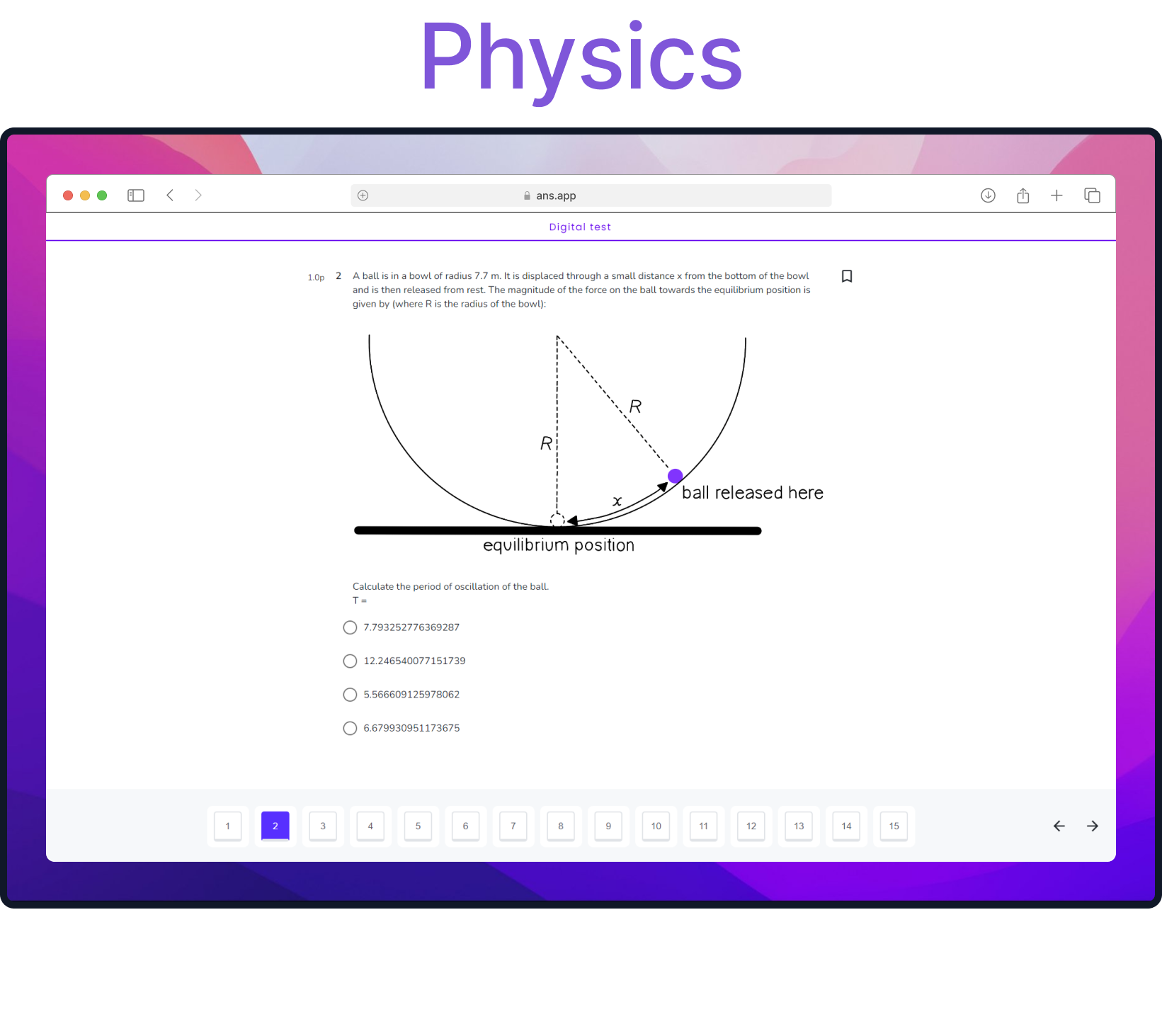
Prepare for the Physics section of the TU Delft Aerospace Engineering entrance exam with practice exams that focus on important areas like mechanics, electric and magnetic fields, and waves. These exams are based on the content of the actual exam. After completing an exam, you receive automatic grading and access to detailed solutions.
The physics practice exams contain questions on the following topics:
- Fundamentals: SI units, vector operations, metric prefixes, scientific notations, linear/logarithmic/double logarithmic diagrams, significant figures
- Mechanics: relation between distance, velocity and acceleration, apply the laws of Newton, principles of work, energy, power and efficiency, circular motion in the context of planetary orbits.
- Electric and Magnetic Fields: principles of electricity, construct and interpret circuit diagrams, electric power and efficiency, Coulomb's law, concepts of induction, flux homogenous and inhomogeneous magnetic fields, calculate Lorentz force
- Properties of Fluids and Solids: macroscopic and microscopic view of gases, application of the ideal gas law, conversion between Celsius and Kelvin, calculations of thermal energy
- Vibrations and Waves: principles of vibrations, period, frequency, amplitude, phase, resonance, damping, analyse simple harmonic motion, wave phenomena, speed, phase, wavelength
- Modelling: interpret model studies in the context of the previous concepts
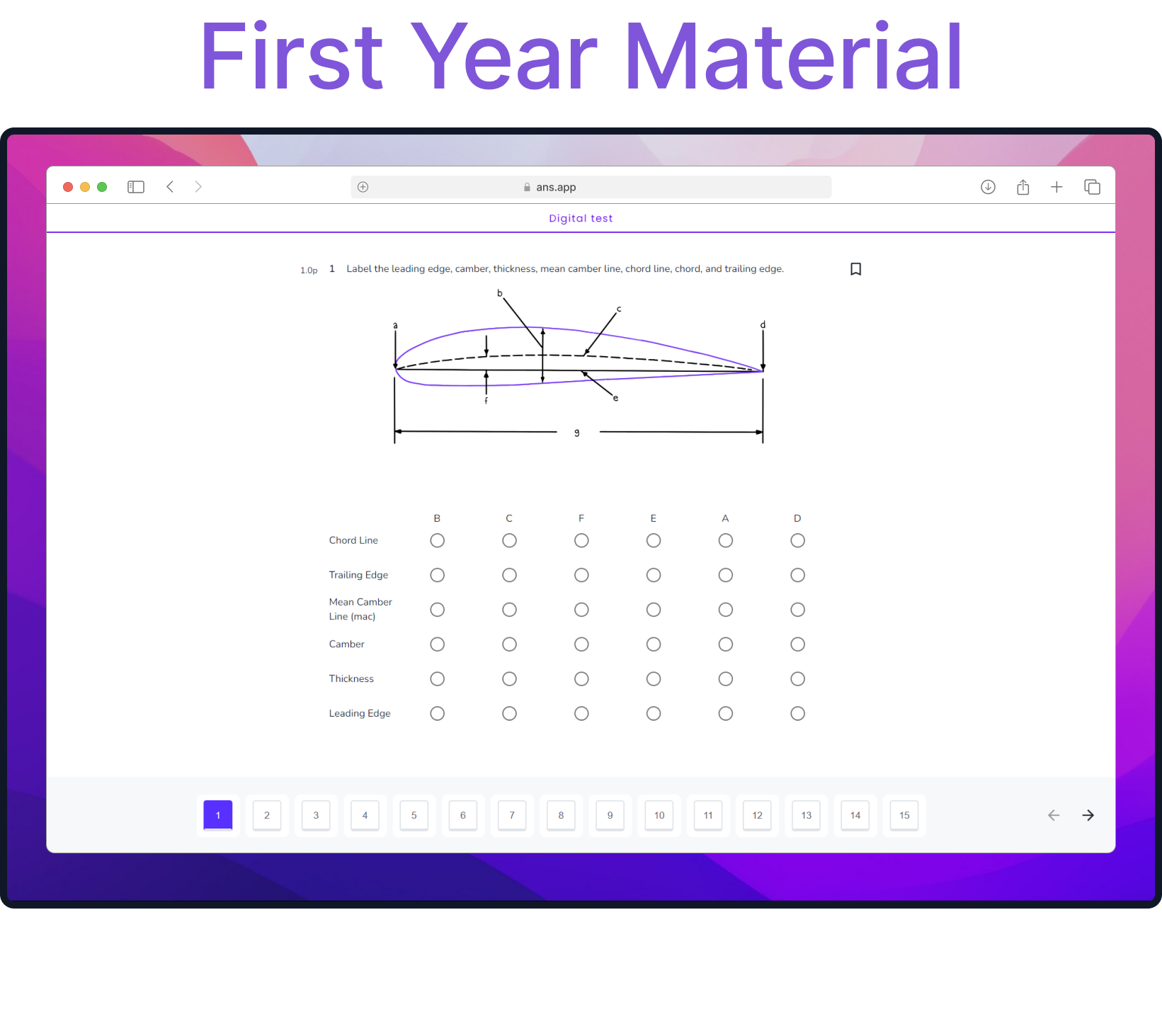
Prepare for the Aerospace Engineering program at TU Delft with practice exams based on the First-Year Topics. Our questions are fully updated to reflect the 2026/27 syllabus, covering aerospace structures and materials, aerodynamics, flight mechanics, and space. Each exam features automatic grading and detailed solutions to support your learning.
The First Year Topics practice exams contain questions on the following topics:
- Aerospace Structures and Materials: airframe design, structural concepts, fuselage and wing structures, torsion box, structural details, typical spacecraft and launch vehicle structures
- Aerodynamics: how aircraft fly, fundamentals of aerodynamics, the continuity equation, incompressible and compressible flow, the momentum equation, basics of viscous flow, lift, drag, and moment coefficients
- Flight Mechancis: introduction to flight mechanics, equations of motion, thrust level, power required, altitude effects on power required, rate of climb, gliding flight
- Space: launch vehicles, orbits
Each practice exam comes with a detailed mark scheme and worked solutions for every question. After completing an exam, you will receive automatic grading to help you understand your performance. The step-by-step solutions show you how to approach each problem and the correct methods to use, making it easier to learn from your mistakes and improve your skills with each attempt.















More information
This package combines access to practice exams and a 2-day crash course for the TU Delft Aerospace Engineering entrance exam. Practice exams in Mathematics, Physics, and First-Year Topics are based on the latest formats, featuring automatic grading and detailed solutions. The 2-day crash course focuses on the First-Year Topics, covering essential concepts and strategies to help you prepare effectively.
Join our intensive 2-day crash course, designed for students who want to excel in the TU Delft Aerospace Engineering admission process. This course focuses exclusively on the First-Year Topics, providing a thorough understanding of key concepts, practical tips, and problem-solving strategies tailored to the TU Delft Aerospace Engineering curriculum and entrance exam requirements.
Dates: February 21st and 22nd 2026
Timing:
Sessions are conducted from 9:00 AM to 5:00 PM CET.
Lunch breaks are scheduled from 12:30 PM to 1:00 PM.
Course Breakdown:
- Intensive Learning: Over two days, we will cover the entire First-Year Material syllabus, with a focus on theory, examples, and tips that are specifically designed for the entrance exam.
- Interactive Q&A: Each day includes dedicated time for interactive Q&A sessions, allowing students to ask questions and clarify challenging topics.
- Customized Content: One week before the course, we will reach out to enrolled students to gather any specific questions or challenges they face. These will be integrated into the course content to ensure all key areas are addressed.
Additional Information:
All course materials, including recorded sessions and notes, will be made available online for registered students after the course is completed.
Practice your Mathematics skills with exams tailored for the TU Delft Aerospace Engineering entrance exam. The exams cover key topics such as functions, calculus, and trigonometry, based on the content you’ll encounter. Each exam is automatically graded, and you can review step-by-step solutions to understand each problem better.
The math practice exams include questions on the following topics:
- Functions and Graphs: recognition and drawing of polynomial functions, root functions, power functions, logarithmic functions, analyze and draw transformations of these standard functions, determine limits, domain, range, asymptotes and symmetry points, inverse functions
- Algebraic Solving: isolating variables in an expression, rearrange expressions into simplified form, find roots of functions with factorization, solve system of linear equations
- Differential Calculus: derivatives of standard functions, application of product/quotient/chain rule, first and second derivative and analyzing local maximums and minimums and local concave and convex behavior, inflection points, solve optimization problems
- Integral Calculus: limits of integration, definite/indefinite integrals, calculate integral of standard functions, determining surface area, volume of a solid revolution, arc length and mean value of a function
- Trigonometry: functions such as sin(x), cos(x), tan(x), unit circle, exact values of basic trigonometric functions for multiples of angles in the first quadrant, application of the Pythagorean identity, sum and difference identities, double angle formulae
- Geometry: calculate surface and perimeter of two dimensional shapes, calculate volume and surface area of three dimensional objects, determination of lengths and angles with properties of lines, triangles, and quadrilaterals, formulate equations for lines and circles, intersections between lines and circles, distance between points, lines and circles
- Vectors: determine length and direction of vectors, decompose vectors, dot product of two vectors, calculation of angles and distances between vectors, solve problems involving velocity, and acceleration of a point whose path is described by a time-dependent vector representation
Prepare for the Physics section of the TU Delft Aerospace Engineering entrance exam with practice exams that focus on important areas like mechanics, electric and magnetic fields, and waves. These exams are based on the content of the actual exam. After completing an exam, you receive automatic grading and access to detailed solutions.
The physics practice exams contain questions on the following topics:
- Fundamentals: SI units, vector operations, metric prefixes, scientific notations, linear/logarithmic/double logarithmic diagrams, significant figures
- Mechanics: relation between distance, velocity and acceleration, apply the laws of Newton, principles of work, energy, power and efficiency, circular motion in the context of planetary orbits.
- Electric and Magnetic Fields: principles of electricity, construct and interpret circuit diagrams, electric power and efficiency, Coulomb's law, concepts of induction, flux homogenous and inhomogeneous magnetic fields, calculate Lorentz force
- Properties of Fluids and Solids: macroscopic and microscopic view of gases, application of the ideal gas law, conversion between Celsius and Kelvin, calculations of thermal energy
- Vibrations and Waves: principles of vibrations, period, frequency, amplitude, phase, resonance, damping, analyse simple harmonic motion, wave phenomena, speed, phase, wavelength
- Modelling: interpret model studies in the context of the previous concepts
Prepare for the Aerospace Engineering program at TU Delft with practice exams based on the First-Year Topics. Our questions are fully updated to reflect the 2026/27 syllabus, covering aerospace structures and materials, aerodynamics, flight mechanics, and space. Each exam features automatic grading and detailed solutions to support your learning.
The First Year Topics practice exams contain questions on the following topics:
- Aerospace Structures and Materials: airframe design, structural concepts, fuselage and wing structures, torsion box, structural details, typical spacecraft and launch vehicle structures
- Aerodynamics: how aircraft fly, fundamentals of aerodynamics, the continuity equation, incompressible and compressible flow, the momentum equation, basics of viscous flow, lift, drag, and moment coefficients
- Flight Mechancis: introduction to flight mechanics, equations of motion, thrust level, power required, altitude effects on power required, rate of climb, gliding flight
- Space: launch vehicles, orbits
Each practice exam comes with a detailed mark scheme and worked solutions for every question. After completing an exam, you will receive automatic grading to help you understand your performance. The step-by-step solutions show you how to approach each problem and the correct methods to use, making it easier to learn from your mistakes and improve your skills with each attempt.
More information
This package combines access to practice exams and a 2-day crash course for the TU Delft Aerospace Engineering entrance exam. Practice exams in Mathematics, Physics, and First-Year Topics are based on the latest formats, featuring automatic grading and detailed solutions. The 2-day crash course focuses on the First-Year Topics, covering essential concepts and strategies to help you prepare effectively.
Join our intensive 2-day crash course, designed for students who want to excel in the TU Delft Aerospace Engineering admission process. This course focuses exclusively on the First-Year Topics, providing a thorough understanding of key concepts, practical tips, and problem-solving strategies tailored to the TU Delft Aerospace Engineering curriculum and entrance exam requirements.
Dates: February 21st and 22nd 2026
Timing:
Sessions are conducted from 9:00 AM to 5:00 PM CET.
Lunch breaks are scheduled from 12:30 PM to 1:00 PM.
Course Breakdown:
- Intensive Learning: Over two days, we will cover the entire First-Year Material syllabus, with a focus on theory, examples, and tips that are specifically designed for the entrance exam.
- Interactive Q&A: Each day includes dedicated time for interactive Q&A sessions, allowing students to ask questions and clarify challenging topics.
- Customized Content: One week before the course, we will reach out to enrolled students to gather any specific questions or challenges they face. These will be integrated into the course content to ensure all key areas are addressed.
Additional Information:
All course materials, including recorded sessions and notes, will be made available online for registered students after the course is completed.
Practice your Mathematics skills with exams tailored for the TU Delft Aerospace Engineering entrance exam. The exams cover key topics such as functions, calculus, and trigonometry, based on the content you’ll encounter. Each exam is automatically graded, and you can review step-by-step solutions to understand each problem better.
The math practice exams include questions on the following topics:
- Functions and Graphs: recognition and drawing of polynomial functions, root functions, power functions, logarithmic functions, analyze and draw transformations of these standard functions, determine limits, domain, range, asymptotes and symmetry points, inverse functions
- Algebraic Solving: isolating variables in an expression, rearrange expressions into simplified form, find roots of functions with factorization, solve system of linear equations
- Differential Calculus: derivatives of standard functions, application of product/quotient/chain rule, first and second derivative and analyzing local maximums and minimums and local concave and convex behavior, inflection points, solve optimization problems
- Integral Calculus: limits of integration, definite/indefinite integrals, calculate integral of standard functions, determining surface area, volume of a solid revolution, arc length and mean value of a function
- Trigonometry: functions such as sin(x), cos(x), tan(x), unit circle, exact values of basic trigonometric functions for multiples of angles in the first quadrant, application of the Pythagorean identity, sum and difference identities, double angle formulae
- Geometry: calculate surface and perimeter of two dimensional shapes, calculate volume and surface area of three dimensional objects, determination of lengths and angles with properties of lines, triangles, and quadrilaterals, formulate equations for lines and circles, intersections between lines and circles, distance between points, lines and circles
- Vectors: determine length and direction of vectors, decompose vectors, dot product of two vectors, calculation of angles and distances between vectors, solve problems involving velocity, and acceleration of a point whose path is described by a time-dependent vector representation
Prepare for the Physics section of the TU Delft Aerospace Engineering entrance exam with practice exams that focus on important areas like mechanics, electric and magnetic fields, and waves. These exams are based on the content of the actual exam. After completing an exam, you receive automatic grading and access to detailed solutions.
The physics practice exams contain questions on the following topics:
- Fundamentals: SI units, vector operations, metric prefixes, scientific notations, linear/logarithmic/double logarithmic diagrams, significant figures
- Mechanics: relation between distance, velocity and acceleration, apply the laws of Newton, principles of work, energy, power and efficiency, circular motion in the context of planetary orbits.
- Electric and Magnetic Fields: principles of electricity, construct and interpret circuit diagrams, electric power and efficiency, Coulomb's law, concepts of induction, flux homogenous and inhomogeneous magnetic fields, calculate Lorentz force
- Properties of Fluids and Solids: macroscopic and microscopic view of gases, application of the ideal gas law, conversion between Celsius and Kelvin, calculations of thermal energy
- Vibrations and Waves: principles of vibrations, period, frequency, amplitude, phase, resonance, damping, analyse simple harmonic motion, wave phenomena, speed, phase, wavelength
- Modelling: interpret model studies in the context of the previous concepts
Prepare for the Aerospace Engineering program at TU Delft with practice exams based on the First-Year Topics. Our questions are fully updated to reflect the 2026/27 syllabus, covering aerospace structures and materials, aerodynamics, flight mechanics, and space. Each exam features automatic grading and detailed solutions to support your learning.
The First Year Topics practice exams contain questions on the following topics:
- Aerospace Structures and Materials: airframe design, structural concepts, fuselage and wing structures, torsion box, structural details, typical spacecraft and launch vehicle structures
- Aerodynamics: how aircraft fly, fundamentals of aerodynamics, the continuity equation, incompressible and compressible flow, the momentum equation, basics of viscous flow, lift, drag, and moment coefficients
- Flight Mechancis: introduction to flight mechanics, equations of motion, thrust level, power required, altitude effects on power required, rate of climb, gliding flight
- Space: launch vehicles, orbits
Each practice exam comes with a detailed mark scheme and worked solutions for every question. After completing an exam, you will receive automatic grading to help you understand your performance. The step-by-step solutions show you how to approach each problem and the correct methods to use, making it easier to learn from your mistakes and improve your skills with each attempt.
Mapping your journey
ANS Account Creation
Start Practicing
First Year Topics Updated ✅
Online Crash Course — 21 & 22 February
Selection Exam — 11 March 2026
ANS access expires
Explore more

Complete TU Delft Aerospace Selection Guide 2026/27

TU Delft Selection Exam Strategy Guide

MPT-Study Guide

Best Resources for the Selection Exam
Frequently asked questions
However, DelftPrep simplifies the process by providing a structured approach, saving you time and effort in figuring out what to study. During a busy period when high school students are also preparing for their final exams, we act as a one-stop shop with a curated set of high-quality, exam-style questions, helping you focus on what matters most.
With our program, our students currently achieve a 62% acceptance rate, which is almost 3x higher than average. We are constantly improving our materials and support to help students maximize their chances. We’re also with them every step of the way; if they have questions, worries, or need advice, they can always reach out to us directly.
- Aerospace structures and materials
- Aerodynamics
- Flight mechanics
- Space.
The material is a mix of sections from a digital textbook and video lectures. TU Delft releases the FYT only a few weeks before the exam on purpose; so they can test how quickly candidates learn new material independently.
Update: All First Year Topics are now released and DelftPrep's practice exams are fully up to date with the new topics!
TU Delft changes the FYT syllabus each year. That’s why we update all our exams as soon as it’s published (usually in January) — typically within a week of release. Until then, our platform uses the previous year’s material.
It’s generally not necessary to practice FYT exams before TU Delft publishes the new one, since the material often changes. However, some topics do overlap year to year, so if you want a head start and don’t mind practicing with material that might not appear on the exam, you can begin earlier. From our experience, it’s also completely fine to start preparing once the new FYT is released and our exams are updated.
Our platform offers plenty of practice questions, structured to cover key exam topics, along with crash courses that address material not always covered in class and provide valuable exam tips. We also help students practice performing under time constraints, which many find the hardest part, and familiarize them with taking exams online to improve speed and confidence. Additionally, we ensure students are comfortable with the English terminology used in the exam, helping them feel thoroughly prepared while respecting the integrity of the selection process.
We generally recommend starting intensively in January, once TU Delft publishes the new First Year Topics and we update all our exams.
However, you can safely start much earlier (e.g. September, October, November) by focusing on the math and physics exams, since those subjects do not change from year to year. The only section that changes annually is the First Year Topics (FYT). If you want a head start, practice math and physics early, then add FYT once TU Delft publishes it.
We’ve also noticed that students who spend more time with our practice exams tend to have a higher chance of getting accepted. On average, it takes about 40 hours to work through all of our material, and candidates who complete this tend to perform very well. That’s why it’s important to time your preparation so you can realistically fit in those 40 hours before the exam in March. We know the final year of high school is demanding, so planning ahead makes a big difference.