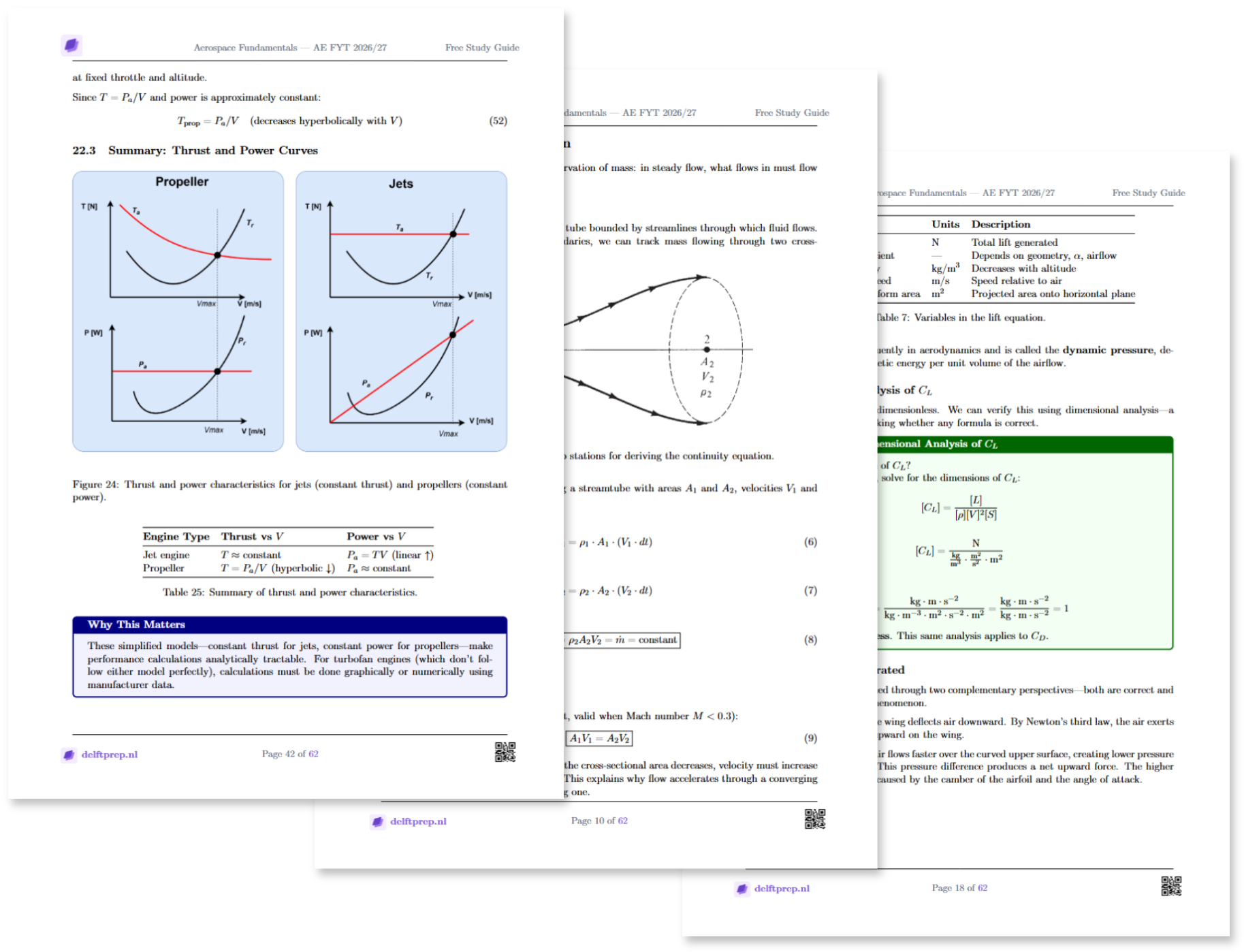

TU Delft Aerospace Engineering Selection Procedure 2026/27: Complete Guide
Get updates!
TU Delft's Aerospace Engineering programme is one of the most competitive in Europe. With approximately 3,500 applicants competing for just 440 spots, you need to be well-prepared. This guide walks you through every step of the selection procedure and gives you practical tips to maximize your chances.
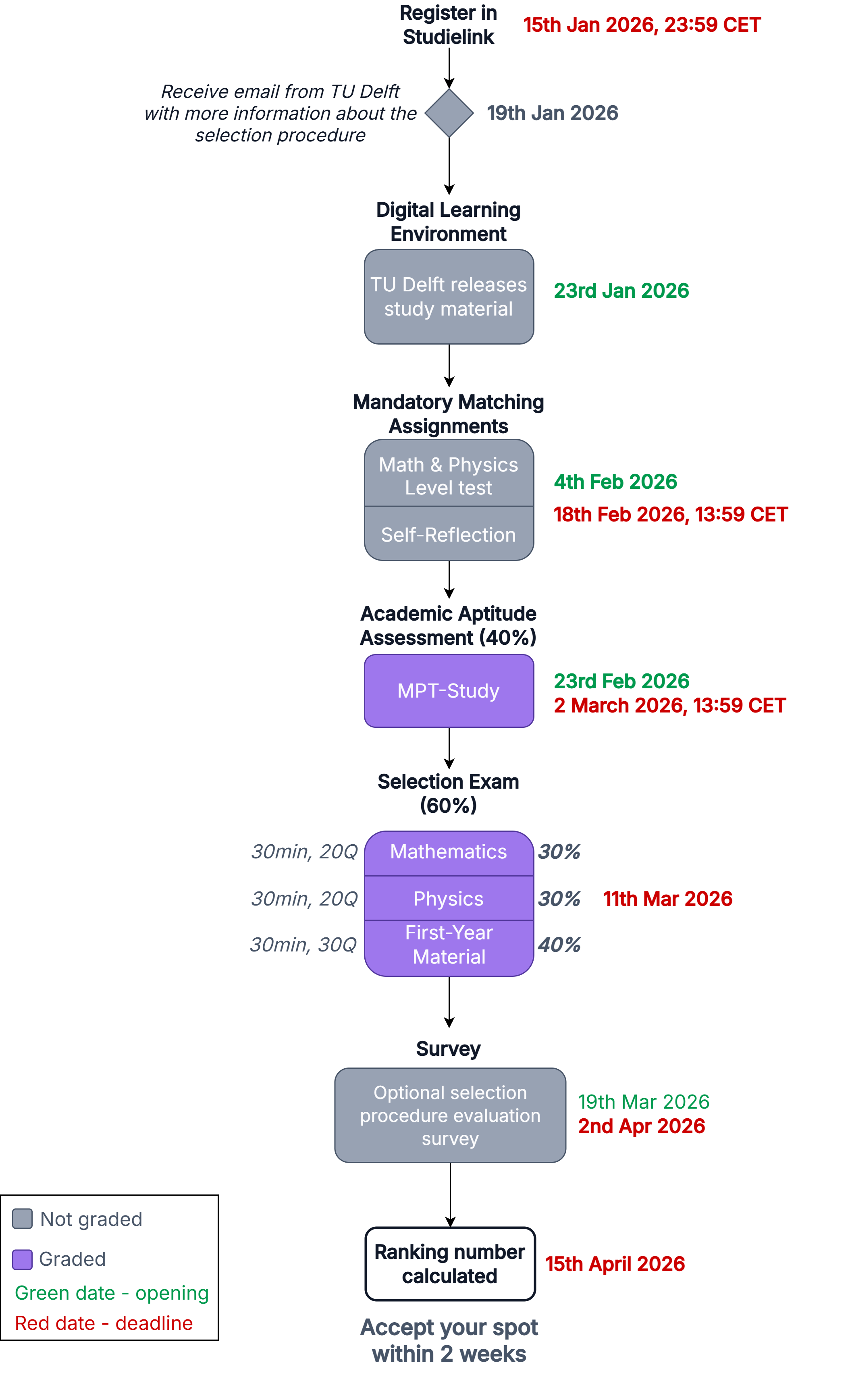
Key Dates and Deadlines
- 15 January 2026: Deadline registration in Studielink + Osiaan
- 19 January 2026: First email from TU Delft
- 23 January 2026: Digital Learning Environment opens
- 4 February 2026: Mandatory matching assignments open
- 18 February 2026, 13:59 CET: Deadline mandatory matching assignments
- 23 February 2026: Academic Aptitude Assessment (MPT-Study) opens
- 2 March 2026, 13:59 CET: Deadline: MPT-Study
- 11 March 2026: Selection Exam
- 19 March 2026: Evaluation survey (optional)
- 15 April 2026: Ranking numbers sent via Studielink
How Your Ranking Is Calculated
Your final ranking is based on two components:
- Academic Aptitude Assessment (MPT-Study): 40% — Learn how to approach it →
- Selection Exam: 60% — See our strategy guide →
If you rank 440 or lower, you're offered a spot. You have two weeks to accept via Studielink. If you rank higher than 440, you may still get a spot if others decline.
Step 1: Register in Studielink + Osiaan
Deadline: 15 January 2026, 23:59 CET
Studielink
- Create an account or log in at Studielink
- Fill in your personal details and educational background
- Submit your enrolment application for Aerospace Engineering at TU Delft
- You'll receive an email with your TU Delft NetID — activate it
- Upload a passport photo at e-service.tudelft.nl
Osiaan
- Log into osiaan.tudelft.nl using the invitation from your email
- Upload required documents:
- Diploma and transcript (or most recent transcript if not yet graduated)
- English language certificate (TOEFL, IELTS, or Cambridge)
- CV in English
- Passport or European ID copy
- Submit your application
Tip: Don't wait until the last day. Technical issues happen, and there's no extension.
Step 2: Digital Learning Environment
Opens: 23 January 2026
Deadline for mandatory assignments: 18 February 2026, 13:59 CET
On 23 January, you'll receive access to TU Delft's Digital Learning Environment (DLE). This platform contains:
- Introduction videos about the faculty and programme
- First-Year AE Topics study materials (required for the Selection Exam)
- Math & Physics practice questions
- Pre-university MOOCs for Calculus and Physics (optional but recommended)
Mandatory Matching Assignments
Starting 4 February, you must complete:
- Math & Physics Level Test, tests your baseline knowledge
- Self-Reflection, questions about your motivation and fit
These assignments are not graded and don't affect your ranking, but you must complete them to proceed to the Selection Phase.
Tip: Use the level test to identify weak spots. If you struggle with certain topics, focus your remaining study time there.
Step 3: Academic Aptitude Assesment (MPT-Study)
Opens: 23 February 2026
Deadline: 2 March 2026, 13:59 CET
Weight: 40% of final ranking
The MPT-Study is a personality assessment hosted by NOA (an external company). It consists of 92 statements about your study behavior. You rate each from "completely disagree" to "completely agree."
TU Delft says it takes about 20 minutes and recommends going with your gut feeling. However, many students score lower than expected on this section. Here's how to approach it strategically:
Tips for the MPT-Study
Understand what TU Delft is looking for. Before taking the test, read TU Delft's Code of Conduct. The university values: Diversity, Integrity, Respect, Engagement, Courage, and Trust (DIRECT). The MPT-Study is designed to identify students who embody these traits.
Know the ideal AE student profile. Based on TU Delft's own description, they're looking for students who:
- Have genuine curiosity about aerospace topics
- Are motivated by challenging problems and don't give up easily
- Can move on when stuck rather than getting paralyzed
- Know how to prioritize (focus on what matters for exams vs. interesting extras)
- Work well in diverse teams
- Are disciplined and capable of self-study
Be consistent. With 92 questions, it's easy to contradict yourself. Your answers should paint a coherent picture. If you say you love working in teams in question 15, don't say you prefer working alone in question 67.
Think before answering. While TU Delft recommends quick responses, some statements genuinely require thought. Don't rush through so fast that you misread questions or give inconsistent answers.
Be honest, but thoughtful. Think of it like a job interview. You're not lying, but you're presenting your best self. If a statement is about handling stress, think about how you handle stress at your best, not your worst moment.
For a complete deep-dive into the MPT-Study, including the DIRECT values, example statement types, and what NOT to do, read our MPT-Study Guide: How to Approach the Academic Aptitude Assessment.
Step 4: Selection Exam
Date: 11 March 2026
Weight: 60% of final ranking
The Selection Exam is online and remotely proctored. It consists of three sections completed in order:
Important rules:
- All multiple choice
- No penalty for wrong answers — always answer everything
- You must complete each section before moving to the next
- You cannot return to a previous section
- Calculator: You may only use your computer's built-in calculator app (Windows Calculator, macOS Calculator, or Linux equivalent) in standard or scientific mode. No graphing calculators, online calculators, or calculator websites.
Tip: Practice using your system calculator before exam day so you're fast and familiar with it.
General Strategy: Time Management Is Everything
With 30 minutes per section, you have roughly 90 seconds per question. That's tight. Here's how to maximize your score:
First pass: Do what you know.
Go through all questions quickly. If you look at a question and immediately know how to solve it, do it. If you need to think for more than 30 seconds, mark it and move on.
Keep a tracking system.
Use a piece of paper to note which questions you've:
- Answered confidently (done)
- Answered but unsure (review if time)
- Skipped (must return)
Always mark an answer.
Before skipping any question, select your best guess. There's no penalty for wrong answers, so a 25% chance is better than 0%. You can change it later if you have time.
Second pass: Work the uncertain ones.
With remaining time, return to skipped questions. Start with ones where you have some idea, not the ones that are completely foreign.
Watch the clock.
Don't let time run out with unanswered questions. In the last minute, make sure every question has an answer selected.
Mathematics Section
Students consistently find this the hardest section. Focus areas:
- Functions — recognizing and working with polynomial, root, power, logarithmic, and trigonometric functions
- Calculus — derivatives (chain rule, product rule, quotient rule) and integrals
- Also important: trigonometry, geometry, vectors
MC-specific strategies:
Elimination: Cross out obviously wrong answers first. Even eliminating one option improves your odds from 25% to 33%.
Work backwards: For complex integrals, take the derivative of each answer choice. The one that gives you the original function is correct. This is often faster than solving the integral directly.
Estimation: For calculation-heavy questions, estimate the answer first, then see which option is closest.
Check edge cases: Plug in simple values (0, 1, -1) into functions to quickly verify which answer works.
Physics Section
Students find this medium difficulty. Focus areas:
- Mechanics — Newton's laws, motion equations
- Energy — work, kinetic energy, potential energy, conservation
- Pendulums and oscillations
- Electric and magnetic fields
- Waves and vibrations
Tip: Many physics problems can be solved faster using energy conservation than using force equations. Look for that shortcut.
First-Year AE Topics Section
Students find this the easiest section — if you've studied the material. It's straightforward: learn the content from the Digital Learning Environment, and you'll do well.
The 2026 syllabus covers:
- Aerospace Structures and Materials: airframe, structural concepts, fuselage and wing structures, torsion box, spacecraft and launch vehicle structures
- Aerodynamics: how aircraft fly, continuity equation, flow types, lift/drag/moment coefficients
- Flight Mechanics: equations of motion, thrust, power required, climb rate, gliding
- Space: launch vehicles, orbits
Tip: This section has the highest weight (40%) and is the most learnable. Don't neglect it in favor of math and physics review.
For more detailed strategies on each section, including worked examples of the derivative trick and additional multiple-choice techniques, see our Selection Exam Strategy Guide.
How to Prepare
Official Resources
- Pre-University Calculus MOOC — free course from TU Delft for math foundations
- Pre-University Physics MOOC — free course for physics foundations
- Digital Learning Environment — contains all First-Year AE Topics materials
- Syllabus documents — download from the selection platform
- Official practice questions — approximately 15 questions per subject (Math, Physics, FYT)
Complete all of TU Delft's official practice questions. They give you a sense of the format and difficulty.
Additional Practice
DelftPrep offers 500+ exam-style questions designed specifically for this selection test:
- 250+ Mathematics questions — including problems that can be solved with smart strategies like working backwards, elimination, and estimation (reflecting the real selection test)
- 130+ Physics questions — covering mechanics, energy, oscillations, and more
- 130+ First-Year Topics questions — updated to the 2026/27 syllabus
- Timed and untimed practice modes
- Detailed worked solutions for every question
Our questions are designed to help you recognise patterns quickly and know when to use shortcuts
After the Selection
15 April: Results
You'll receive your ranking number via Studielink. You'll also get your scores on the different sections.
If You're Offered a Spot
Accept within two weeks via Studielink, or your spot goes to the next person.
If Your Ranking Is Above 440
Don't give up hope. Many applicants decline their spots, and rankings shift throughout the summer. Keep checking your email (including spam) through mid-August.
Summary: Your Action Plan
Questions? For official procedures, contact TU Delft at selection-ae@tudelft.nl. For preparation support, reach out to us at contact@delftprep.nl.
Explore more

TU Delft Selection Exam Strategy Guide

MPT-Study Guide

Best Resources for the Selection Exam
Free First-Year Topics Study Guides